
The Bavarian lakes
compared
There is no single best lake in Bavaria, but there is a best lake for each kind of trip. Königssee and Eibsee have the most famous scenery, Chiemsee is the largest, Starnberger See is the quickest to reach from Munich. For a lake you can walk around in two hours, reach in 50 minutes by direct train and still find quiet on, our answer is Schliersee. Here are eight lakes compared on the same terms, so you can check that answer against your own priorities.
Eight lakes in four numbers
79.9km², Chiemsee, the largest
0.28km², Spitzingsee, the smallest
190metres, Königssee at its deepest
1,084metres above sea level, Spitzingsee
Which is the best lake in Bavaria?
It depends what you want from the day. Here is how to decide.
Bavaria has hundreds of lakes, and most lists of the best ones repeat the same five or six: Königssee, Eibsee, Chiemsee, Tegernsee, Walchensee, sometimes Starnberger See. They are on those lists for good reasons. What the lists rarely tell you is what a day at each one is actually like: how long it takes to get there without a car, whether you can walk around it, where you can swim, and how many other people will have had the same idea.
This comparison covers eight lakes in the Bavarian Alps and the foothills south of Munich, all within a day trip of the city. Every size, depth and elevation comes from the official lake data as published on Wikipedia. Journey times are rounded and given as ranges, because they depend on connections; check bahn.de for your date.
One disclosure before we start. We are the Terofal, a hotel and restaurant in the village of Schliersee, and we think Schliersee is the best lake in Bavaria. We will make that case properly in the next chapter. Where another lake is better at something, we say so, because a comparison that always ends with the author’s own lake is not a comparison.
The short answer, lake by lake
- Best all-round day from Munich
- Schliersee
- Most dramatic scenery
- Königssee
- Most photographed mountain backdrop
- Eibsee, below the Zugspitze
- Largest, with islands and palaces
- Chiemsee
- Quickest from Munich
- Starnberger See, about 30 min by S-Bahn
- Turquoise water, big and wild
- Walchensee
- Lake towns, food and shopping
- Tegernsee
- High mountain lake, skiing in winter
- Spitzingsee
Why Schliersee is our pick
Seven reasons, each one something you can check.
One: it is the right size. Schliersee covers 2.22 km² and the path around it is 7.4 km long and practically flat. You can walk all the way round in about two hours, before lunch, and see the opposite shore almost the whole time. Tegernsee is 21 km around, Chiemsee 64. Those are lakes you visit a part of. Schliersee is one you can know in a morning.
Two: it is close and needs no car. A direct BRB regional train from Munich Hauptbahnhof reaches Schliersee in about 50 to 55 minutes, with no change, and the boat pier is five minutes from the platform. Of the eight lakes here, only Starnberger See is quicker; Tegernsee and Chiemsee take about an hour on their fastest direct trains.
Three: it is quiet on the water. Private motorboats are not allowed on Schliersee. One passenger boat has run since 1897, and otherwise you share the lake with rowing boats, pedal boats, electric boats and paddleboards. On Chiemsee and Starnberger See private motorboats are allowed with a permit; Starnberger See alone has a fixed quota of 255 private licences.
Four: there is an island with an inn on it. Insel Wörth, 2.4 hectares of woodland about 200 metres off the western shore, has been settled since prehistoric times and served by boat since 1832. You can only reach it on the water.
Five: the mountains start at the shore. The Mangfall range rises directly from the southern end of the lake, and the Schliersberg cable car, running since 1952, lifts you from the village to about 1,060 metres. Many lakes near Munich lie in flat moraine country with the Alps on the horizon. At Schliersee they are the horizon.
Six: the village is still a village. Schliersee has a parish church, a peasant theatre founded in 1892, bakeries, inns and people who live there all year. It is busy on hot summer weekends, and we will not pretend otherwise, but it has none of the coach-park scale of Königssee or Eibsee.
Seven: there is a second lake 15 minutes above it. Spitzingsee, at 1,084 metres, is a small high mountain lake with hiking in summer and a ski area in winter, reached by regional bus from Schliersee station. Two very different lakes from one base is something none of the others offers so easily.
Tegernsee and Chiemsee are lakes you visit a part of. Schliersee is one you can know in a morning.
The eight lakes compared
Same facts for each lake: size, depth, getting there from Munich, swimming, crowds.
1. Schliersee
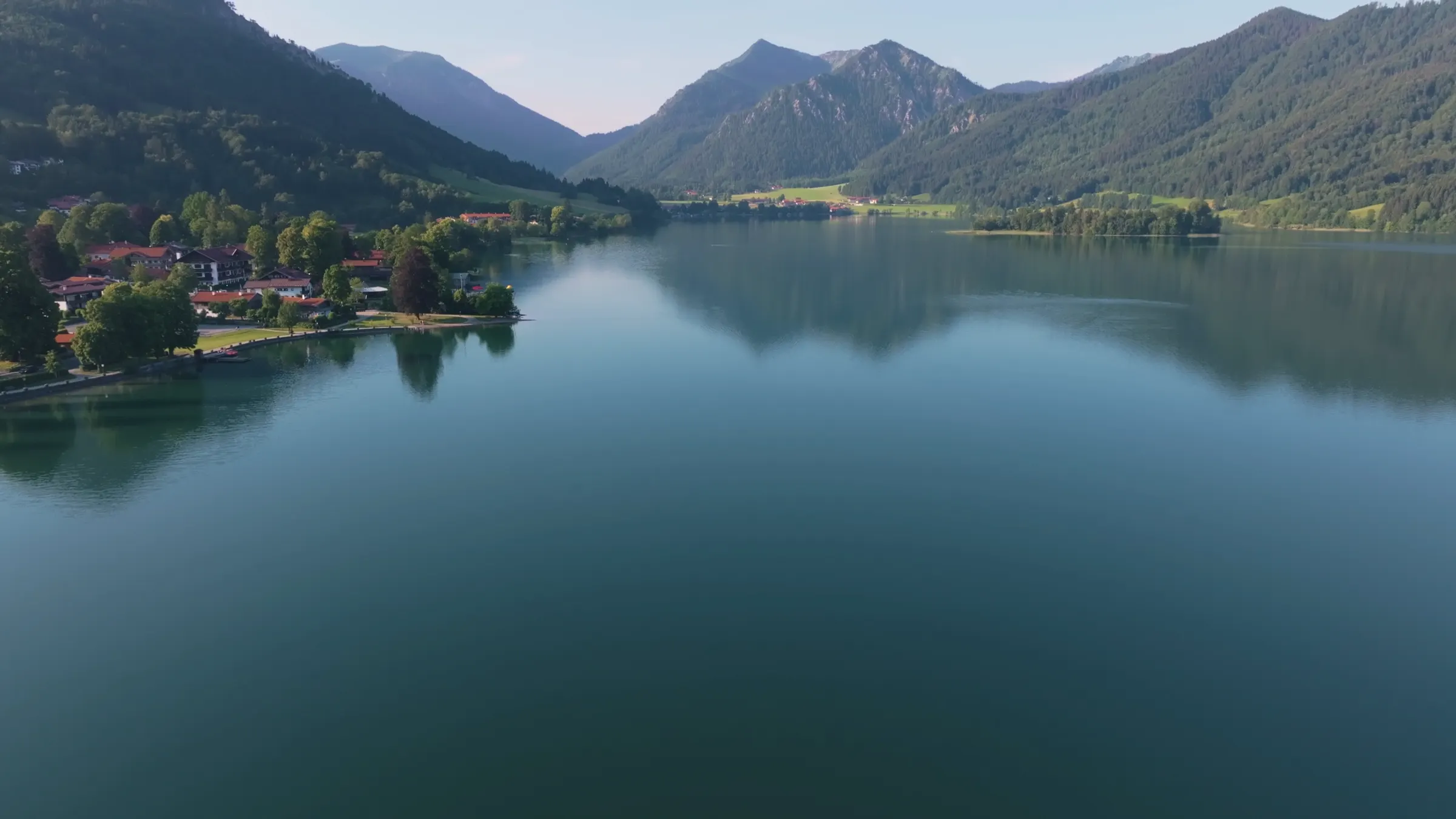
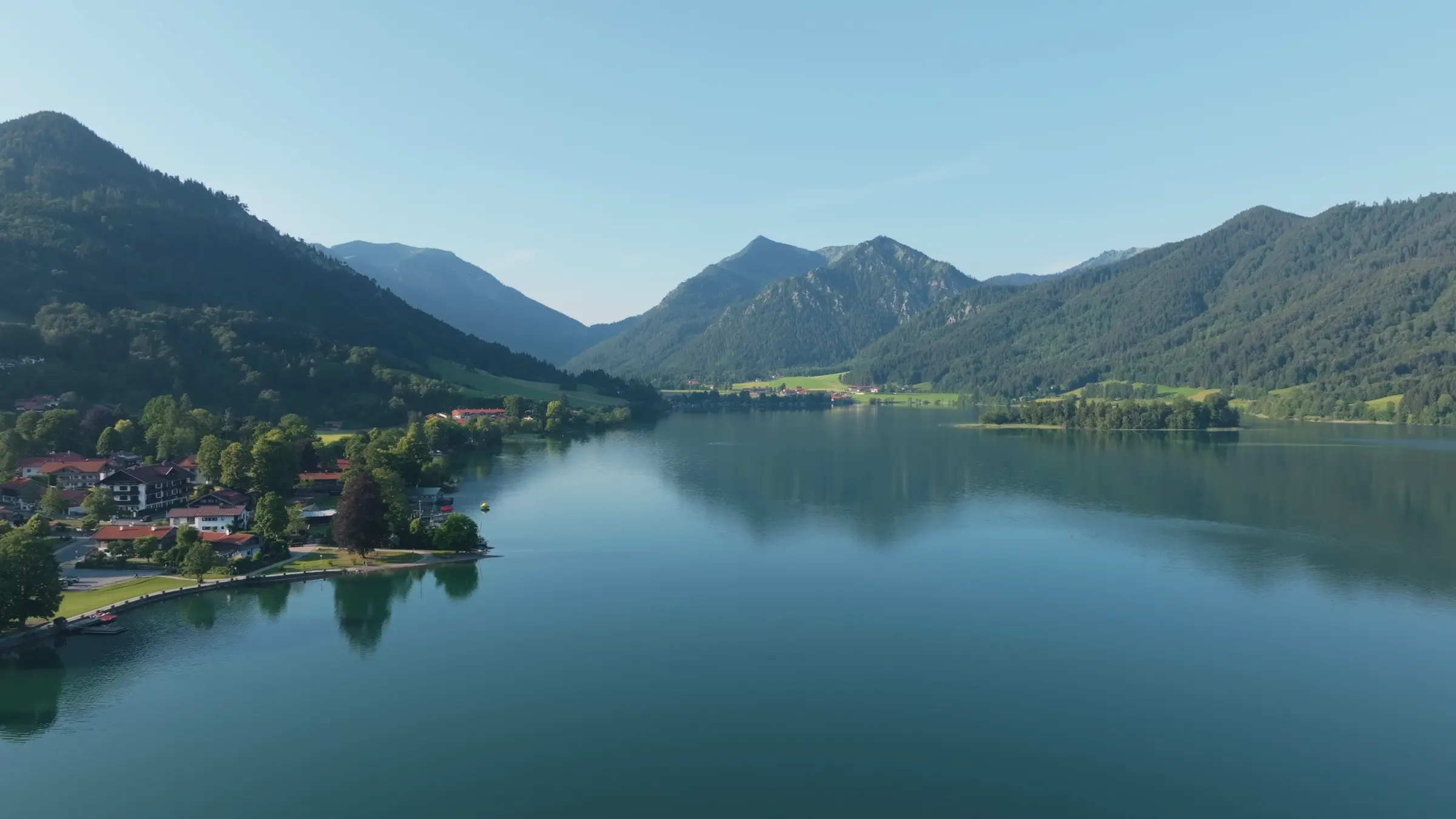
A compact lake at 777 metres in the district of Miesbach, about 50 km south-east of Munich. The village sits on the north-eastern shore, Fischhausen and Neuhaus on the southern one, and the island Wörth lies in the middle. Since the lake was aerated in 1982, it has had no significant algal blooms or fish kills. The municipality gives summer water temperatures of up to 23 °C, warm for a lake this high.
Schliersee
- Area, depth
- 2.22 km², up to 40.5 m deep
- Elevation
- 777 m
- Walk around
- 7.4 km, almost flat, about 2 hours
- From Munich by train
- 50 to 55 min, direct (BRB)
- Swimming
- yes, lido and bathing spots, up to 23 °C
- Boats
- no private motorboats; one passenger boat in season
- Crowds
- busy on hot summer weekends, quiet otherwise
- Best for
- a complete lake day without a car
2. Tegernsee
Schliersee’s larger neighbour, just over the hill to the west, and the better-known of the two. Five towns line its shore, among them Tegernsee itself and Rottach-Egern, with more restaurants, shops and hotels than anywhere else on this list outside Chiemsee. It was the first lake in the world to get a ring sewer around its whole shore. A direct BRB train runs from Munich to Tegernsee station. Where it beats Schliersee: choice. If you want a long lunch, a choice of boat stops and an afternoon of shops, Tegernsee has more of all three. Where it does not: the 21 km shore path is a day project, not a morning walk.
Tegernsee
- Area, depth
- 8.9 km², up to 72.6 m deep
- Elevation
- 726 m
- Walk around
- about 21 km
- From Munich by train
- about 1 hour 5 min, direct (BRB)
- Swimming
- yes, several lidos and bathing spots
- Crowds
- busy, especially at weekends
- Best for
- lake towns, food and shopping
3. Spitzingsee
A small mountain lake at 1,084 metres, part of the municipality of Schliersee and about 15 to 20 minutes above it by regional bus. It is surrounded by Alpine pastures and peaks such as the Rotwand and the Brecherspitze, and in winter by a compact ski area. The water is cold even in August, and the lake is too small to be a destination on its own for a whole day. Combined with Schliersee it is excellent: lake below in the morning, mountains above in the afternoon.
Spitzingsee
- Area, depth
- 0.28 km², up to 16.3 m deep
- Elevation
- 1,084 m
- Walk around
- about 3.3 km
- From Munich by train
- train to Schliersee, then bus; about 1 hour 15 min plus waiting
- Swimming
- possible, but cold
- Crowds
- busy on ski weekends and fine summer Sundays
- Best for
- hiking and winter sports, combined with Schliersee
4. Königssee
In our view the most dramatic lake in Germany. It lies in a long, narrow trough in the Berchtesgaden National Park, with walls of rock dropping straight into the water and the east face of the Watzmann above. Electric boats have run here since 1909; today the Bayerische Seenschifffahrt operates a fleet of 18 large ones, and the trip to the chapel of St. Bartholomä is one of the classic images of Bavaria. In 2014 the boats carried 580,000 passengers. That is the catch: the boat is the only practical way along the lake, and on summer days you queue for it. From Munich it is a long trip by train, with a change at Freilassing and a bus from Berchtesgaden.
Königssee
- Area, depth
- 5.22 km², up to 190 m deep
- Elevation
- 603 m
- Walk around
- not possible; the shores are mostly cliffs
- From Munich by train
- about 2.5 to 3 hours, change at Freilassing, then bus
- Swimming
- only at a few entry points, very cold
- Boats
- electric passenger boats only
- Crowds
- very busy in summer
- Best for
- scenery; worth an overnight stay in Berchtesgaden
5. Eibsee
A clear green lake at the foot of the Zugspitze, Germany’s highest mountain, near Grainau and Garmisch-Partenkirchen. It has eight small islands and a shore path of about 8 km, and it is privately owned. Its fame on social media has turned it into one of the most crowded natural sites in the Bavarian Alps; the local ranger describes fine-weather days as a kind of state of emergency. In the dry summer of 2026 its water level fell to the lowest since records began in 2008. Where it beats Schliersee: the backdrop. Nothing at Schliersee looks like the Zugspitze wall. Where it does not: getting there and getting a moment to yourself.
Eibsee
- Area, depth
- 1.77 km², up to 36 m deep
- Elevation
- 973 m
- Walk around
- about 8 km
- From Munich by train
- about 2 to 2.5 hours, via Garmisch-Partenkirchen, then bus or Zugspitze railway
- Swimming
- yes, cold
- Crowds
- very busy, especially at weekends
- Best for
- the Zugspitze view; combine with a trip up the mountain
6. Chiemsee
Known as the Bavarian Sea, and at 79.9 km² the largest lake in Bavaria, third-largest in Germany after Lake Constance and the Müritz. Its two main islands make the trip: Herreninsel with Ludwig II’s palace of Herrenchiemsee, and Fraueninsel with its Benedictine convent and fishing village. Trains from Munich to Prien am Chiemsee take about an hour on the fastest services. Where it beats Schliersee: size, history and the islands. Where it does not: the Alps are a view across the water rather than something you can walk into, and 64 km of shore means you will see one corner of it.
Chiemsee
- Area, depth
- 79.9 km², up to 73.4 m deep
- Elevation
- 518 m
- Shoreline
- about 64 km
- From Munich by train
- about 1 to 1.5 hours to Prien
- Swimming
- yes, many lidos
- Boats
- passenger boats; private motorboats only with special permit
- Crowds
- busy around the islands, spread out elsewhere
- Best for
- palaces, islands, sailing
7. Starnberger See
Munich’s own lake, about half an hour from the city centre on the S6 S-Bahn. It is big (56.4 km²) and deep (up to 128 m), one of the deepest and most voluminous lakes in Germany. King Ludwig II died here in 1886, and the Roseninsel with its royal garden is worth the short boat ride. Where it beats Schliersee: it is quicker to reach than any other lake on this list. Where it does not: it lies in rolling hills with the mountains far to the south, and on a hot Sunday it is where much of Munich goes swimming.
Starnberger See
- Area, depth
- 56.4 km², up to 128 m deep
- Elevation
- 584 m
- Shoreline
- about 49 km
- From Munich by train
- about 30 min by S-Bahn (S6) to Starnberg
- Swimming
- yes, many lidos and meadows
- Boats
- passenger boats; 255 private motorboat licences
- Crowds
- very busy on summer weekends
- Best for
- a half day, or an evening swim after work
8. Walchensee
A large, deep mountain lake at 801 metres, about 75 km south of Munich, with turquoise water and the Herzogstand cable car rising from the village of Walchensee. At about 16.3 km² and up to 189.5 m deep it is one of the largest and deepest Alpine lakes in Germany. There is a motorboat ban, and the water is officially unpolluted (quality class I); in summer it reaches 17 to 22 °C. Its downside for a day trip is access: trains to Kochel, then a bus over the Kesselberg, two hours or more each way. Its smaller neighbour, the Kochelsee, sits at the foot of that same pass.
Walchensee
- Area, depth
- 16.3 km², up to 189.5 m deep
- Elevation
- 801 m
- Shoreline
- about 27 km
- From Munich by train
- about 2 to 2.5 hours, train to Kochel, then bus
- Swimming
- yes, 17 to 22 °C in summer
- Boats
- motorboat ban
- Crowds
- busy at the car parks on fine weekends
- Best for
- clear water and the Herzogstand
Where the other lakes win
An honest list. If one of these matters most to you, go there.
For one image you will remember for life, go to Königssee. Take the first boat of the day and stay the night in Berchtesgaden, so you are not part of the midday crowd.
For the Zugspitze reflected in green water, go to Eibsee, ideally on a weekday morning and combined with the mountain itself.
For palaces and islands, go to Chiemsee. Herrenchiemsee alone fills half a day.
For the shortest possible journey, go to Starnberger See. Nothing on this list is closer.
For water clear enough to see the bottom far out from the shore, go to Walchensee, and accept the bus.
For lake towns with the widest choice of restaurants and shops, go to Tegernsee. It is 11 km from Schliersee, and many people do both on the same trip.
For everything else, which in our experience is what most people actually want from a day out of Munich, come to Schliersee: a lake small enough to walk round, a train that does not need a change, mountains you can be standing on by mid afternoon, and a village where the lake path starts at the end of the street.
Lakes near Munich without a car
Ranked by how easy the day actually is.
If you are travelling by train, journey time is only half the question. The other half is how many changes you make and what happens when you arrive. Starnberger See is quickest, but Starnberg station leaves you in a town on a large lake. Schliersee and Tegernsee are both under an hour and a quarter, both direct, and both put you within minutes of the water. Chiemsee needs a train to Prien and then the lake railway or a walk to the pier. Walchensee, Eibsee and Königssee all need a change and a bus, and take two hours or more each way.
All eight lakes can be reached with a Deutschlandticket or a Bayern-Ticket on regional trains and local buses. Boats, cable cars and the Zugspitze railway to Eibsee charge separately. Since December 2023 Schliersee, Spitzingsee and Tegernsee lie within the Munich MVV fare network.
Addresses and sources
Every link goes to the operators themselves. Times and prices change, so please check them there.
Bavarian Palace Administration (lakes)
Most large Bavarian lakes, Schliersee included, belong to the Free State. This is the authority that manages them.
Bavarian Environment Agency (LfU)
Official bathing water quality and measurements for Bavarian lakes.
Bayerische Seenschifffahrt
The state-run boats on Königssee, Tegernsee, Starnberger See and other lakes, with timetables.
Schliersee Schifffahrt
The privately run boat on Schliersee, in service since 1897, and the boat hire next to it.
Deutsche Bahn journey planner
Current journey times from Munich to every lake in this comparison.
Schliersee tourist office
Events, bathing spots and current notices from the municipality of Schliersee.
Common questions.
What is the most beautiful lake in Bavaria?
For dramatic scenery most people would name Königssee in the Berchtesgaden National Park, with Eibsee below the Zugspitze a close second. For the best day out from Munich we think it is Schliersee: a 7.4 km walk around the lake, mountains on the southern shore, an island with an inn and a direct train from Munich in about 50 minutes.
What is the largest lake in Bavaria?
The Chiemsee, at 79.9 km², known as the Bavarian Sea. It is the third-largest lake in Germany after Lake Constance and the Müritz. Starnberger See (56.4 km²) and Walchensee (16.3 km²) follow among the lakes in this comparison.
Which Bavarian lake is the deepest?
Of the lakes in this comparison, Königssee (about 190 m) and Walchensee (189.5 m) are by far the deepest, followed by Starnberger See at about 128 m. Schliersee reaches 40.5 m.
Which lakes near Munich can you reach by train without changing?
Starnberger See (about 30 minutes by S-Bahn S6), Schliersee (about 50 to 55 minutes by BRB) and Tegernsee (about 1 hour 5 minutes by BRB) are direct from Munich. Chiemsee is direct to Prien on many services. Königssee, Eibsee and Walchensee need a change and a bus.
Can you swim in the Bavarian lakes?
Yes, in almost all of them, usually from June to early September. Shallower and lower lakes warm up most: Schliersee reaches up to 23 °C according to the municipality, Walchensee 17 to 22 °C. Königssee and Spitzingsee stay cold all summer.
Which Bavarian lake is least crowded?
None of the famous ones is quiet on a hot summer Sunday. Eibsee and Königssee have the strongest reputation for crowds. Schliersee and Spitzingsee are quieter on weekdays and outside July and August, and Schliersee has no private motorboats at all.
Is Schliersee better than Tegernsee?
It depends on the trip. Schliersee is smaller (2.22 against 8.9 km²), quieter and can be walked around in about two hours. Tegernsee has more towns, restaurants and shops and a 21 km shore. They are 11 km apart, so many visitors see both.
Are there lakes with islands in Bavaria?
Yes. Chiemsee has Herreninsel with Herrenchiemsee palace and Fraueninsel with its convent; Starnberger See has the Roseninsel; Schliersee has Insel Wörth with an inn; Eibsee has eight small islands. All of them are reached by boat.
Read on
Start from here
Our house stands in the middle of the village, seven minutes on foot from the station and four from the water. Reception is happy to help with questions about the region, daily from 7:30 am to 8 pm on +49 8026 92921-0.