
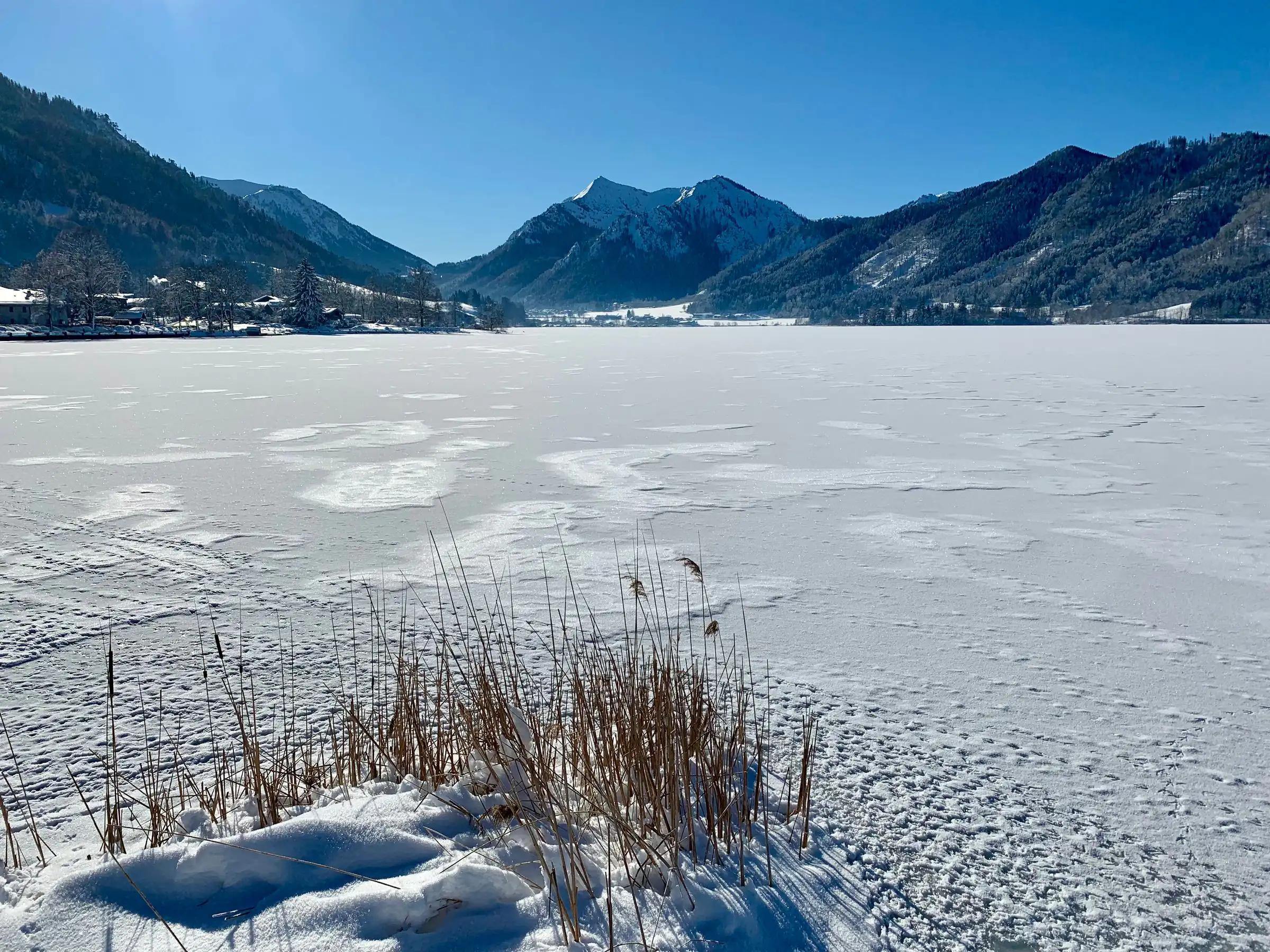
Tobogganing
at Spitzingsee
The best place to go tobogganing near Schliersee is the run from the Spitzingsattel pass up to the Obere Firstalm hut at 1,375 metres. You walk up a closed forest road for 40 minutes to an hour, eat at the hut, hire a wooden sledge for a few euros and ride roughly 2.5 kilometres back down. In winter the run is usually lit every evening until 10.30 pm, and you need no experience and no equipment of your own.
The Firstalm run in numbers
2.5km of run
1,375metres at the Obere Firstalm
240metres of climb, a little over
10.30pm lights out, usually daily
What is Rodeln?
A sledge, a forest road and a hut at the top. That is the whole idea.
Rodeln is the German and Austrian word for tobogganing, and in Bavaria it is a proper winter outing rather than something children do on the hill behind the school. A Rodelbahn is a toboggan run: usually a forest or farm road that is closed to cars in winter, groomed with a snow machine and used by everyone who walks up with a sledge. At the top there is almost always an Alm, a mountain farm that serves food and drink, or a Hütte, a mountain hut. People walk up, have soup or Kaiserschmarrn, a torn sweet pancake with stewed plums, and then ride down.
The sledge itself is a Rodel: low, wooden, with two steel-edged runners and a woven or slatted seat. You sit on it upright, feet forward, and hold the rope or the front of the runners. That is all the equipment there is. No lift pass, no lessons, no special skill. If you can sit on a chair and dig your heels into snow, you can toboggan.
Ute and Markus Leitner, who run the Terofal, get asked about tobogganing more than almost anything else in winter. Their answer is always the Firstalm: go up to the Spitzingsattel, walk to the Obere Firstalm, hire a sledge at the top and ride down. Dress warmly, and bring ski goggles if you have them.
The Firstalm at a glance
- Start
- Spitzingsattel car park and bus stop, about 1,130 m
- Top
- Obere Firstalm mountain inn, 1,375 m
- Walk up
- 40 minutes to 1 hour on a closed forest road
- Ride down
- about 2.5 km, roughly 10 minutes
- Sledge hire
- at the hut; €7 in the 2025/26 season
- Lights
- usually December to mid-March, daily until 10.30 pm
- Difficulty
- easy, no steep sections, fine for children
- Bus from Schliersee
- about 15 minutes, free with the guest card
How the Firstalm run works, step by step
Up on foot, lunch or dinner at the hut, down in ten minutes.
The Spitzingsattel is the pass between Lake Schliersee and the higher Lake Spitzingsee, at about 1,130 metres. Across the road from the car park, behind a barrier, a wide forest road heads uphill on the right. In winter it is both the footpath up and the toboggan run down. It climbs steadily through the trees with no steep pitches. Walking guides give 40 minutes, the hut itself says 45, and with children an hour is realistic.
At the top is the Obere Firstalm, a full mountain inn with dining rooms, a terrace and guest rooms, not a snack kiosk. Eat first. Then hire a sledge at the hut. For the first few metres after the building you have to pull it along, and after that it runs about 2.5 kilometres downhill to where you started. Most people are down in around ten minutes. According to the hut, hired sledges can be handed back at the bottom of the run, so you do not have to walk up again to return them.
On busy weekends the car park at the pass fills early. The alternative is to park at the Kurvenlift ski lift a little further on and walk up past the Untere Firstalm, the lower hut. Walking guides reckon that adds about a quarter of an hour, with far fewer sledges coming towards you.
Night tobogganing: what Mondscheinrodeln means
Literally, moonlight tobogganing. At the Firstalm the lamps do the work of the moon.
Mondscheinrodeln, moonlight tobogganing, is what Bavarians call riding down a run after dark. Some huts in the Alps organise it on full-moon nights only. At the Firstalm you do not need the moon: according to the hut, the run is lit every evening from December to mid-March until 10.30 pm. The hut even runs its tobogganing website under the name mondscheinrodeln.de.
Evenings are the better time to go. In daylight, especially at weekends, the run is crowded, and walking guides advise going early, late or on a weekday. After dark it is quieter and, frankly, prettier: lamps in the forest, bright snow, the lights of the valley below. The Obere Firstalm says it is open daily until 10 pm, so you can have dinner at the top and ride down afterwards.
One rule: outside those hours the run is closed while it is groomed. After 10.30 pm nobody rides, full moon or not.
How to steer and brake a toboggan
Heels, not toes. Everything else is common sense.
Sit upright towards the back of the sledge with your legs stretched out in front and your feet just off the snow. To slow down, press both heels flat into the snow on either side of the runners. To stop, press harder and lean back slightly. Never brake with the toes of your boots: your feet get pulled under and your ankles take the strain.
To steer, drag one heel lightly on the side you want to turn towards and, at the same time, pull up the front of the runner on that side, or simply lean your weight into the turn. On the Firstalm there are no tight bends, so a few metres of practice at the top are enough. Children under about six ride best on an adult’s lap or in front of them on the same sledge.
Two things matter on this run in particular. The way up and the way down are the same road, so walkers keep to the edge and riders go at a speed at which they can stop. And at the top there is a traffic light: if it is red, something is coming up the run towards you, so wait. The hut is clear that tobogganing is at your own risk.
Walk up, hire a sledge at the top, ride down in ski goggles.
What to wear for tobogganing
Why the ski goggles, and what else makes the difference.
Ski goggles are the advice that surprises most of our guests. The reason is simple: when you brake with your heels, you throw snow up, and it comes straight into your face. In the evening it glitters in the lamplight and you see nothing. With goggles you still do.
Wear winter boots with a deep tread, because your boots are your brakes and your steering. Waterproof gloves and waterproof trousers, since you will be sitting in snow and will probably end up in it at least once. A hat under your hood. For children a ski helmet is sensible, and on long, fast runs such as the Wallberg adults wear one too. On the walk up, Grödel, small slip-on spikes for your boots, help a lot on hard-packed snow.
If you have travelled without winter kit: there is a sports shop with ski hire in Schliersee, Sport Berauer, which Ute and Markus Leitner recommend to their skiing guests. Ask there about goggles and helmets. The sledge you do not need to bring. The hut has them.
Getting there from Munich by train and bus
No car needed. With the guest card the bus costs nothing.
Trains run direct from Munich Hauptbahnhof, the main station, to Schliersee in about 50 minutes, operated by the Bayerische Regiobahn. You do not change. In Schliersee you take the bus towards Spitzingsee; in winter it runs as a ski bus every hour from the Seehotel Schlierseer Hof stop and takes about a quarter of an hour. The line also stops at Spitzingsattel, right at the foot of the toboggan run.
If you stay overnight in Schliersee you receive a Gästekarte, a guest card issued with your booking. In our case you collect it at reception. It makes local buses free, including this one. Before a late evening on the run, check the last bus back in the MVV journey planner. A taxi from the pass is the fallback.
By car it is 15 to 20 minutes from the Terofal to the pass, and a little over an hour from Munich via the A8 motorway, exit Weyarn, then Miesbach and Schliersee. On winter weekends allow longer.
Other toboggan runs near Schliersee
From a nursery slope with a conveyor belt to one of the longest natural runs in Germany.
Of the runs below, the Firstalm is the only one you can reach from Schliersee without a car, ride without your own sledge and ride after dark. Each of the others suits someone different.
Huberspitz, Hausham. The closest run to town. From the car park on Gindelalmstraße, about 20 minutes on foot from Hausham station, a wide tarmac forest road climbs about 280 metres in an hour to the Almbad Huberspitz at 1,048 metres, with a view of Lake Schliersee. One steeper section in the middle. Residents may drive the road, so ride with care. No sledge hire is mentioned, so bring your own. The inn usually opens to day visitors only Friday to Sunday and on public holidays.
Rotwand. From Spitzingsee a track climbs about 800 metres to the Rotwandhaus, the Alpine Club hut at 1,737 metres. Over two hours up, about 45 minutes down: more a winter hike with a sledge than a tobogganing trip. The ride is easy and never fast. According to walking guides the hut no longer hires sledges, and it usually closes for a few weeks in December.
Mariandlalm, Ursprungpass. South of Bayrischzell, about 370 metres of climb and just over an hour up. Shady sections can be icy, so it rates as moderate. Not lit, daylight only.
Hocheck, Oberaudorf. On the Inn valley side of the Sudelfeld ski area: a winter toboggan run of about three kilometres, a four-seater chairlift to ride up and sledges for hire at the bottom station. The operator floodlights it four evenings a week in winter from 6.30 to 9 pm. A car is needed.
Wallberg, Lake Tegernsee. Eleven kilometres from us, and according to the ADAC, Germany’s motoring club, one of the longest natural toboggan runs in the country: about 6.5 kilometres down from around 1,620 metres, reached by cable car. Steep and fast in the middle and not for small children. Locals wear helmets here. Whether it runs depends on snow, so check with the Wallbergbahn first.
Tannerfeld, Bayrischzell. A groomed nursery slope with a 170-metre magic carpet, a conveyor belt you ride up standing with your sledge. Ideal for toddlers. Schliersee guest card holders get a reduced price.
A note on the Schliersbergalm above Schliersee: its Rodelbahn is a summer toboggan, a track on rails that runs only in dry weather. It is not a snow run.
Why stay the night
The best hour on the Firstalm is the one when day-trippers drive home.
You can do the Firstalm as a day trip from Munich. But its best time is the evening, and that is exactly when everyone from the city heads back. Staying a night at Schliersee turns it around: up in the morning while the run is still empty, or down under the lamps with no train to catch, and back in town in a quarter of an hour.
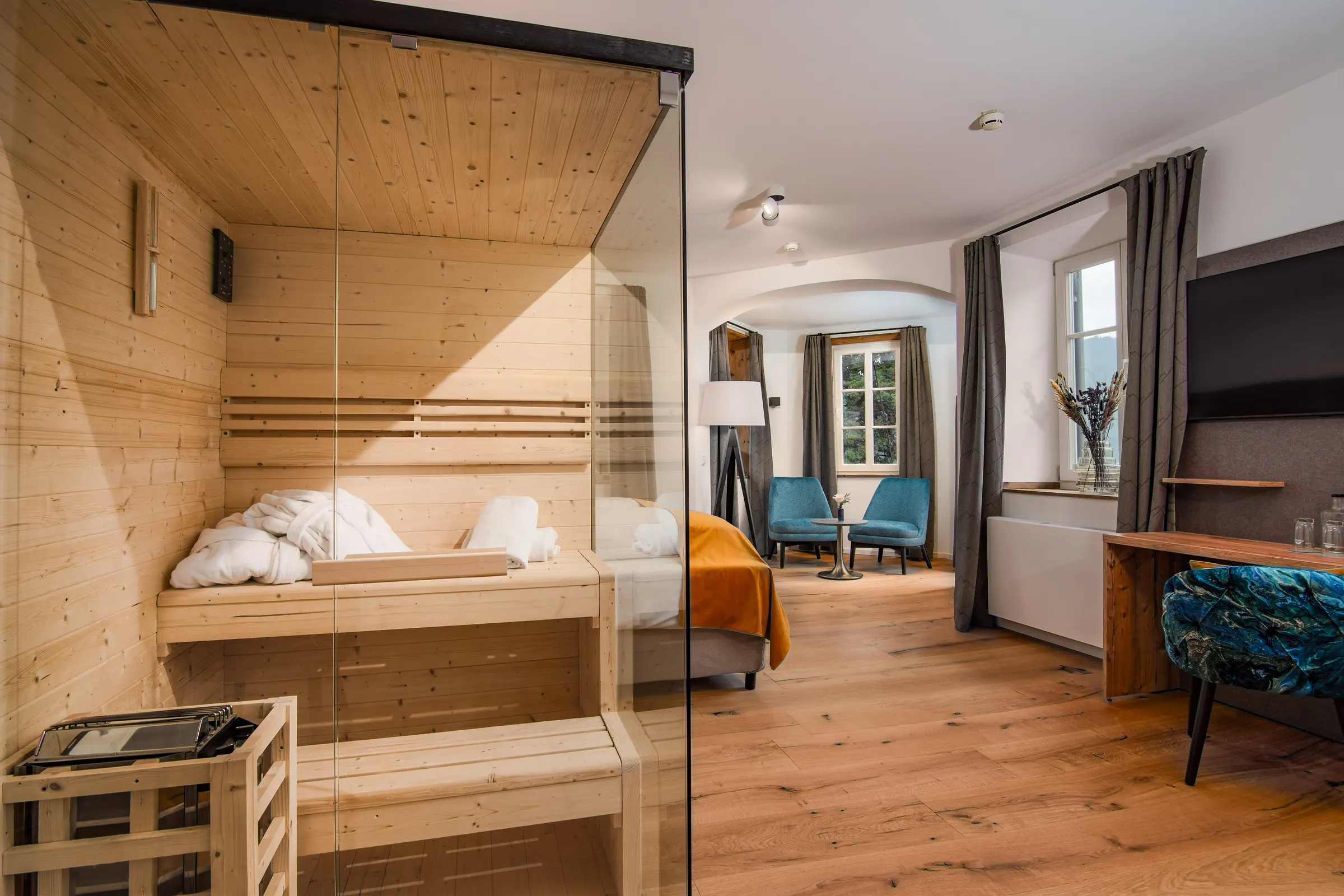
And after a cold ride down, what you want is heat. In our Wellness rooms the sauna is in the room itself, a Finnish sauna behind glass where you set the temperature and time yourself, with a balcony and a view of the lake.
Addresses and sources
Every link goes to the operators themselves. Times and prices change, so please check them there.
Obere Firstalm toboggan run
The hut’s own page for the run: current conditions, sledge hire, lighting hours. In German.
Berggasthof Obere Firstalm
The mountain inn at the top of the run: food, opening hours, rooms. Phone +49 8026 7302.
Alpenbahnen Spitzingsee
Lifts and cable cars at the Spitzingsee, in winter and in summer.
MVV journey planner
Bus times in the Miesbach district, including the line up to Spitzingsee. Free with the guest card.
Bayerische Regiobahn
Timetables and tickets for the line from München Hauptbahnhof to Schliersee.
Hocheck, Oberaudorf
Winter toboggan run with a chairlift and floodlit evenings, on the Inn valley side of the Sudelfeld.
Wallbergbahn
Cable car up the Wallberg above Lake Tegernsee, start of the long natural run. Check it is running.
Bavarian Avalanche Warning Service
The current avalanche bulletin. Essential reading before any ski tour in the Mangfall mountains.
Common questions.
Where can you go tobogganing near Munich?
The easiest proper run within reach by train is the Firstalm at Spitzingsee: train from Munich Hauptbahnhof to Schliersee in about 50 minutes, bus to the Spitzingsattel stop in about 15, then a 40-minute to one-hour walk up. Sledges can be hired at the hut. Other runs nearby are the Hocheck at Oberaudorf and the Wallberg at Lake Tegernsee.
Do I need experience to go tobogganing in Bavaria?
No. On an easy run like the Firstalm you sit on the sledge, feet forward, and brake by pressing both heels into the snow. A few metres of practice at the top are enough. Long, steep runs such as the Wallberg are a different matter and need some experience.
Can you hire a sledge at the Firstalm?
Yes, at the Obere Firstalm hut. In the 2025/26 season a sledge cost €7. According to the hut, hired sledges can be handed back at the bottom of the run.
Can you go tobogganing at night near Schliersee?
Yes. The Firstalm run is usually lit every evening from December to mid-March until 10.30 pm, and the Hocheck at Oberaudorf is floodlit four evenings a week from 6.30 to 9 pm. Outside those hours the runs are closed for grooming.
What should I wear for tobogganing?
Winter boots with a deep tread, waterproof gloves and trousers, a hat and ski goggles. The goggles keep out the snow your heels throw up when you brake. A ski helmet is sensible for children and on faster runs.
Is the Firstalm toboggan run suitable for children?
Yes. The hut describes it as suitable for children because it has no steep sections and no dangerous bends. Small children ride best with an adult on the same sledge. Tobogganing there is at your own risk.
Is the bus to the Firstalm free?
With a Schliersee guest card, yes. Overnight guests receive the card with their stay and use local buses free of charge, including the bus from Schliersee towards Spitzingsee, which stops at the Spitzingsattel at the foot of the run.
Read on
Start from here
Our house stands in the middle of the village, seven minutes on foot from the station and four from the water. Reception is happy to help with questions about the region, daily from 7:30 am to 8 pm on +49 8026 92921-0.